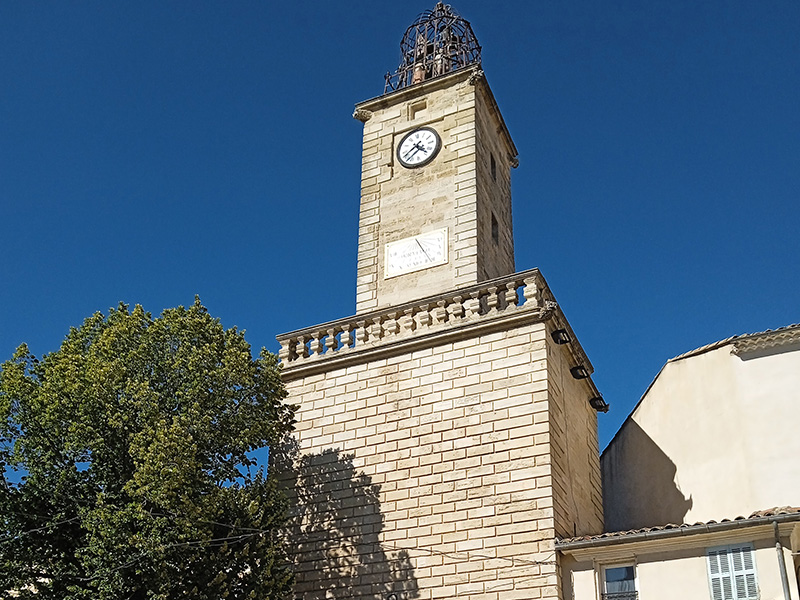
Main view - © Mairie de Lambesc
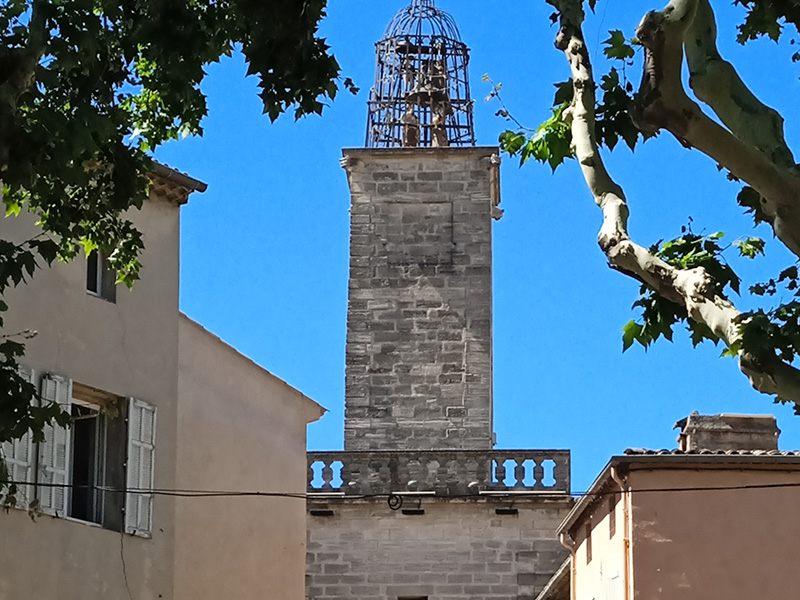
View of Place Jean Jaurès - © Mairie de Lambesc
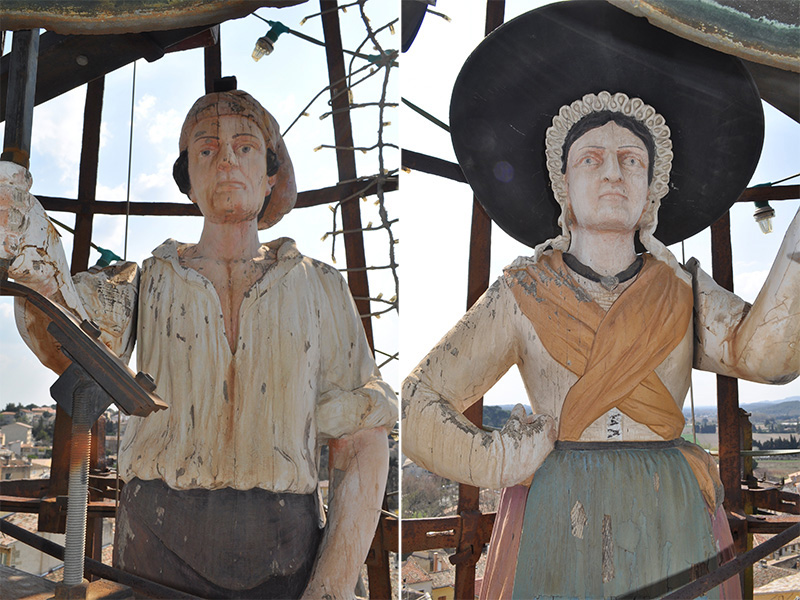
Characters - © Mairie de Lambesc
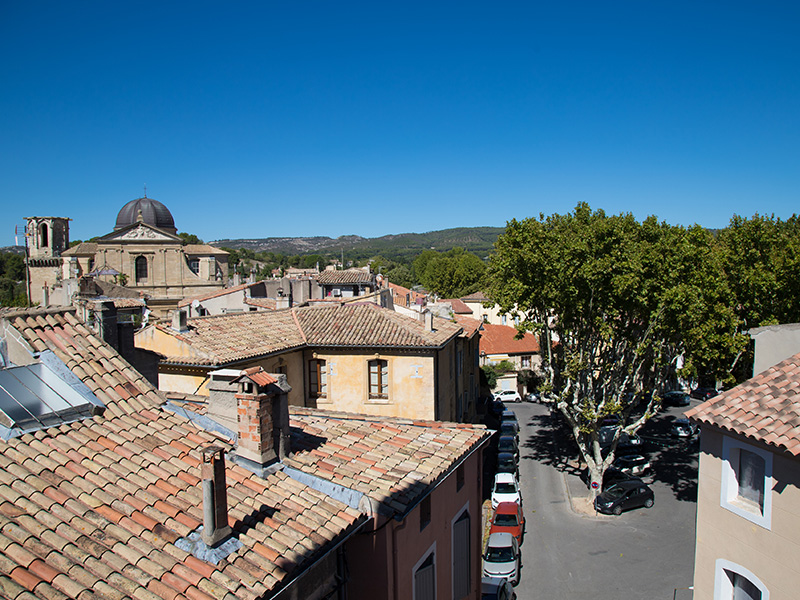
North view - © Mairie de Lambesc
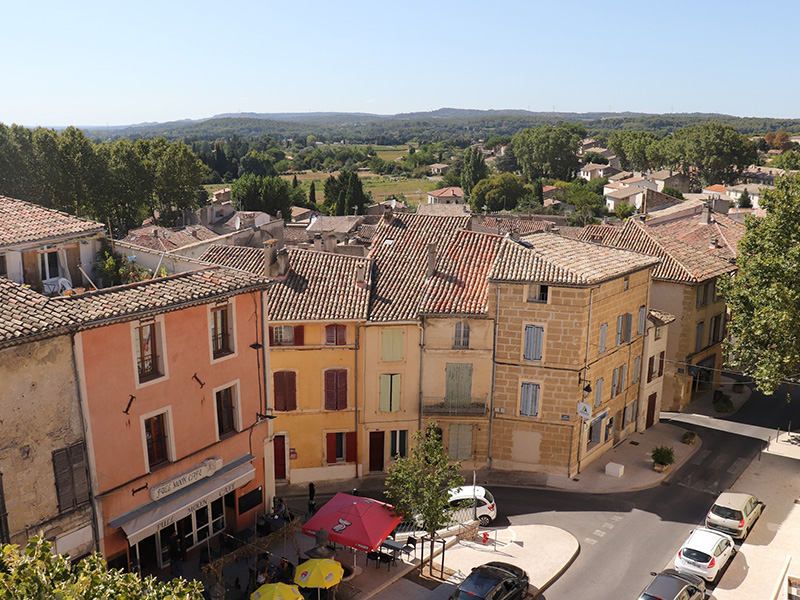
West view - © Mairie de Lambesc

Jacquemard
Rue Grande
Welcome to the foot of the Jacquemard, L’un des plus remarquables de France à la fois par le nombre de ses automates et par leur taille grandeur réelle.
Jacquemart or Jacquemard ?
There are 27 Jacquemarts in France, of which only three take a final « D ». Those of Besançon, Mombrard and Lambesc, Jacoumar in Provençal. Along with Lambesc, 6 other Jacoumarts exist in the southern half of France: the Avignon couple, the Romans géant, the Lavaur Jacoumaro, the three Chinese »s in Aix en Provence, the one in Grau du Roi and the one in Nîmes.
Until now, we've been working on the Jacoumarts in the south of France
A little’history…
Lambesc was equipped with ramparts at the beginning of the 15th century. On the site of today's Jacquemard, stands one of the gates of the ramparts that protected the town, the western gate, known as the Porte de Salon or Portail de la Grand Place. The upper part of the tower, a kind of belfry, was begun in 1626 and completed in 1645. On a square plan, it rises 25 meters above ground level. Designed to house a clock, it had two square openings: on the front, côté Rue Grande, where the current sundial is located, and on the other côté place Jean Jaurès, which is not used today but is still visible, albeit obturated. On this side, two rectangular openings are pierced in the part of the rampart gate. A niche houses a Virgin and Child known as Notre Dame des Neiges
Just above the porch are the town's coat of arms « azure à the Lorraine cross gold ». They were donated to Lambesc in 1453 by Yolande de Vaudemont, Duchess of Lorraine, when her father, King Renacute, gave her the Seigneury of Lambesc, which he had just purchased. These arms, representative of the cross of Anjou, only became the cross of Lorraine later, in 1477, when King René's grandson took it as a rallying sign in his fight against Charles the Tierra, whom he defeated in front of Nancy. The cross of Lorraine is a symbol of the Lorraine region
And the clock?
The first clock with two dials was installed in 1598. One, on the inside of the ramparts (now Place Jean Jaur), told the time; the other, on the outside, with a colored disk, showed the phases of the moon. This disc was replaced in 1611. The mechanism used, a counterweight, was of the so-called "meeting wheel" type, with no balance or anchor, unknown at the time. These clocks only told the time with limited precision, and had to be reset every day according to the indications of a sundial. This explains the presence of such a dial on the main tower, with the inscription « Horat fugit » (the hour flows). The bell telling the time was located inside the tower.
In 1646, this clock was replaced by a Jacquemart clock with four steel automata, installed on the unprotected tower terrace. The inhabitants named the automatons after the monument, which thus became a name of its own. The Jacquemard family was born. The husband, a blacksmith, was named Jacquemard, the wife Margarido, the son Jacquet and the daughter Jacqueto. The children rang the quarter-hours on two small bells; the blacksmith, the hours on a very large bell. He would strike the hour, and between the two strokes, his wife would tell him the time.
The 950-kilo bell bears an engraved inscription: "J.H.S. De mon seul ton je régis toute chose et l’on m’a faite en 1643 ».
- Les transformations du XIXème siècle : In 1827, the clock was refurbished by Rousset, mécanicien à Salon-de-Provence and in 1882, it was replaced by a more précise clock à balancier et ancre déchappement. The old-fashioned metal automata are replaced by wooden models, and the mechanism that operates them is simplified. Margarido no longer makes the reference, but rings the hour with her husband. The children announce what time their parents will strike, and ring the quarter hours on a dome-shaped bell. The family is enclosed in a 4-metre-high wrought-iron bell tower.
The wooden figures were made by sculptor Mouttet of Aix-en-Provence, based on the model of the metal mannequins. The blacksmith, Jacquemard, is 1.65 m tall, Margarido is 1.60 m tall and the children are 1.05 m tall; the father and son are dressed in revolutionary garb, the mother and daughter in Haute Provence costumes, with lace and large flat-brimmed hat. - The twentieth century, a difficult one: All went well until June 11, 1909, when an earthquake annihilated three-quarters of the town. The Jacquemard tower is shaken, the big bell falls at the feet of the blacksmith, stopping the clock, whose intact dial shows twenty-one hours and fifteen minutes, the time of the earthquake.a public subscription launched by the regional newspaper Le Petit Marseillais enabled the clock to be restored to working order. The tower was strengthened by two wrought-iron girdles, which can still be seen today. And the Jacquemard family is back in business. The Jacquemard is classified as a historic monument by ministerial decree dated November 30, 1912.
16 August 1944, a German ammunition train parked at the station was machine-gunned by the Allies and exploded, causing considerable damage to the town, which suffered 22% of its damage. The Jacquemard tower still stands, but the big bell has been dismantled; the 1645 sundial, rebuilt in 1909, falls onto the wall and breaks.
1948, with the town's urgent reconstruction work completed, Mayor Charles Serre decided to restore the clock. Louis Long, the Lambesc clockmaker in charge of the restoration, carried it out with the help of a specialist, Mr. L. Robert. The replaced dial, made of polished glass, comes from Ungerer, a Strasbourg firm renowned for its large clocks.
The ironwork, carpentry and painting were carried out with particular care. on this occasion, the original shades of the Jacquemard family costumes were picked out and reproduced.
At the end of 1980, Jacquemard's malfunctioning and somewhat disused clock stopped striking the hours and had to be restored. Unfortunately, due to a lack of information, the original shades were not restored. Even today, Jacqueto, Jacquet, Margarido and Jacquemard continue to punctuate the days of local residents.
La petite anecdote: In 1993, the French Post Office registered Lambesc's Jacquemard for the issue of a stamp. This will be the second stamp to feature a Jacquemart, after the one issued in Moulins in 1955
The Jacquemard can be visited on the occasion of the Journées du Patrimoine and as part of the visits de l’été in July and August. Information from the Maison du Tourisme: 04 42 17 00 62
Source : Pierre GAZANHES