
La chapelle Saint-Roch
La chapelle Saint-Roch
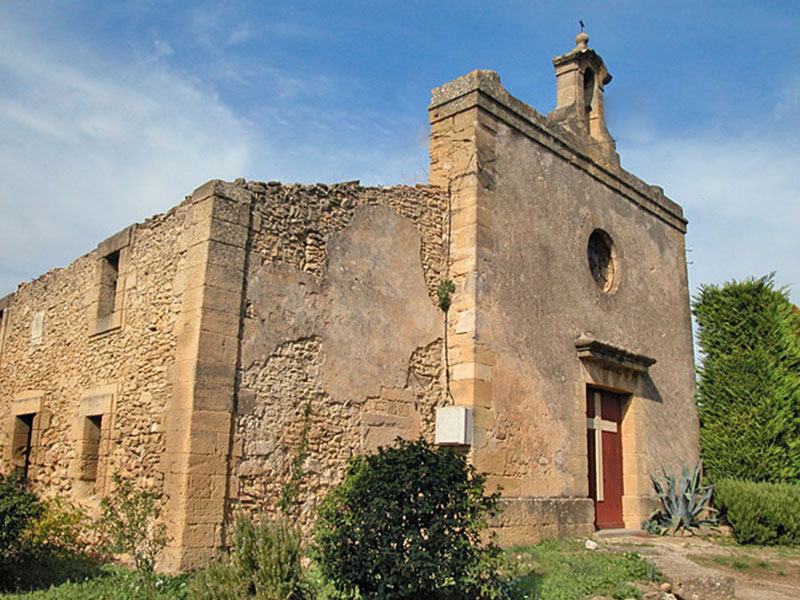
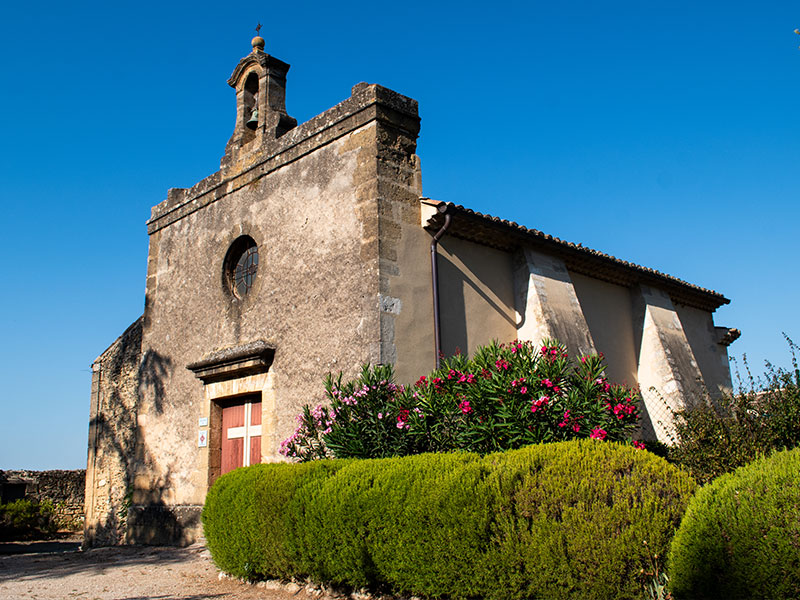
Hidden among the private dwellings is a chapel, still in use today and listed on the Inventaire Supplémentaire des Monuments Historiques in 1943 : the Saint-Roch chapel.
Saint Roch, protector of plague victims :
Saint Roch was born in Montpellier around 1350 to a wealthy family. He decided to renounce his privileges, distributed his wealth to the poor and became a pilgrim. As the Black Death ravaged Europe at the time, he nursed the sick on his journey to Rome. When he caught the plague, Saint Roch withdrew to a forest to become a hermit. Ill and believing he was dying, a dog came into the woods every day to bring him bread to eat. The animal licks his wounds and Saint Roch is cured of the plague. He resumed his pilgrimage to Milan, but was arrested and imprisoned. He remained there for five years, refusing to break his pilgrim vow. He revealed his identity only on the eve of his death, in 1378.
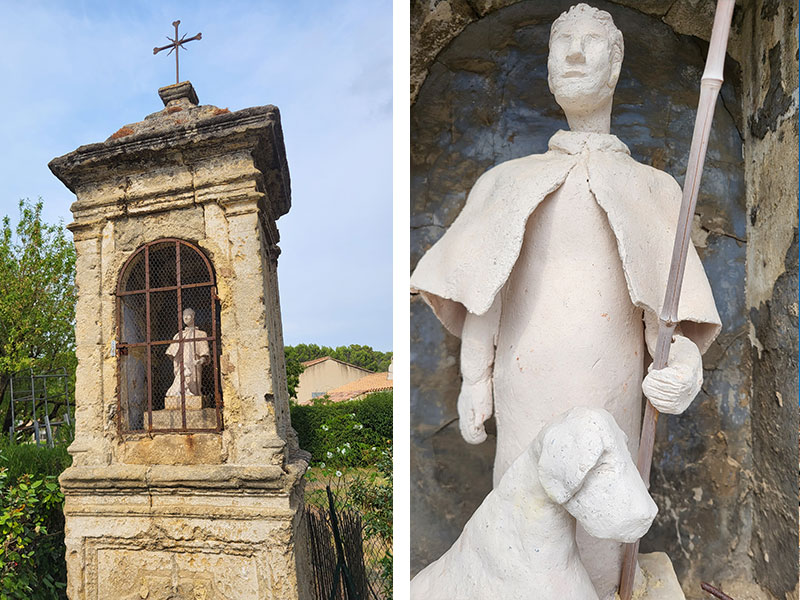
His cult spread throughout Europe and, once canonized, he became the patron saint of plague sufferers, surgeons, dermatologists and apothecaries. He is also a protector of animals. In iconography and statuary, he carries a pilgrim's staff and is accompanied by a dog. He also has a wound on his thigh, a reference to the bubonic plague, from which he kept the stigmata.
Naturally, during major epidemics, he is the first saint the faithful pray to. That's why there's a chapel named after him in Lambesc, a land in Provence particularly hard hit by this plague.
Health at the heart of the chapel :
The chapel that stands before you is built on a former leprosarium : leprosy, an infectious disease caused by a bacterium close to that of tuberculosis, causes lesions on the skin, nerves, mucous membranes, respiratory tract and physical deformities. An incurable disease in the Middle Ages and transmitted by air, towns built leprosaria to isolate and care for the sick from the rest of the healthy population.
In Lambesc, the leprosarium was called " La Maladière " and was in use until 1585, after which lepers were transferred to other centers, including Les Fédons. The Saint-Roch chapel was built by the congregation of the Notre-Dame de la Rose church in 1634 on the site of the Maladière.
Tradition has it that the plague epidemic of 1720 stopped at the chapel doors ! Only one victim of the disease was recorded in Lambesc, reinforcing the cult of the saint. Shortly after the epidemic, many faithful asked to be able to celebrate the feast of Saint Roch in perpetuity, in recognition of his intercession and the protection he had brought to the town during these difficult times. The Archbishop of Aix-en-Provence agreed in 1733, and so August 16, the feast of Saint Roch, is celebrated every year.
The Revolution of 1789 jeopardized the chapel, which was sold as national property and then fell into ruin. It was finally put up for sale in 1820 and 7 Lambescans (Viton, Toche, Mathieu, Boyer, Bernard, Jacques and Etienne) bought the building and rebuilt it.
On August 16, 1944, a German ammunition train arrived at Lambesc station and was machine-gunned: the explosion was so severe that 22% of the town was devastated. At the same time, many of the villagers are at the chapel to celebrate Saint-Roch's Day. The village abbot, Boyer, affixes a plaque in the chapel on which is engraved " The faithful of Lambesc express their gratitude to Saint Roch for the special protection they received on August 16, 1944 when an ammunition train exploded ".
Today, the chapel is still a place of worship, graciously made available to Protestants who, since 1980, have celebrated Sunday worship there and organized church and cultural activities.
Simple architecture :
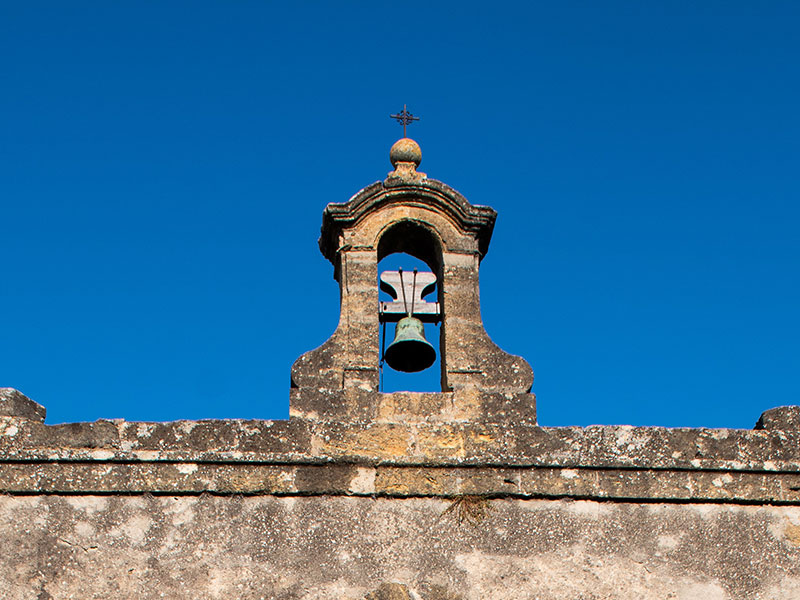
Before you stands a very sober chapel, rectangular in plan, with a single nave and triangular apse. Its façade is topped by a bell tower. Its bell bears the inscription :" Dieu, le Roi, la France ".
Sur la route des oratoires :
Just opposite the chapel, on the other side of the road, is a small stone monument where a statuette is nestled: this is the oratory of Saint-Roch.
What is an oratory ? This small construction placed beside roads and paths protects the faithful and pilgrims on their way. It has a religious function (to protect the faithful and provide a place of worship for prayer) but also a geographical one, as it serves as a landmark and stopping-off point on roads and paths.
Lambesc has 13 oratories on its territory, and the one at Saint-Roch is recognizable by its pilgrim's staff and dog at its side.