Credits: Ville de Lambesc / Conservation du Patrimoine Lambescain
Credits: Ville de Lambesc / Conservation du Patrimoine Lambescain
Credits: Conservation du Patrimoine Lambescain

Credits: Ville de Lambesc

Le Moulin de Bertoire
Le Moulin de Bertoire
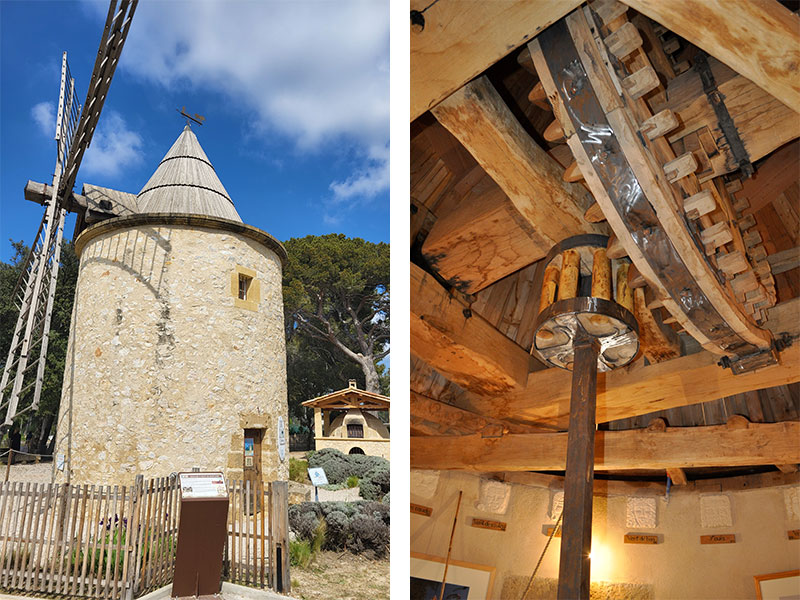
Situated on the Bertoire plateau, Lambesc's mill sits proudly, its wings turning in the wind. But why is it here?
Mills in Provence
It was the return of the Crusaders to Europe in the 12th century that saw the reappearance of the mill on the continent, inspired by those in the Near East. Over the centuries, mills underwent a number of technical improvements, enabling them to grind grain faster and more finely, and thus produce greater quantities and better quality flour. This was all the more important in the Middle Ages, when cereals were the mainstay of the diet. The mill thus became a central element in village life.
How does a windmill work?
The windmill transforms wind energy into mechanical energy to grind cereal grains.
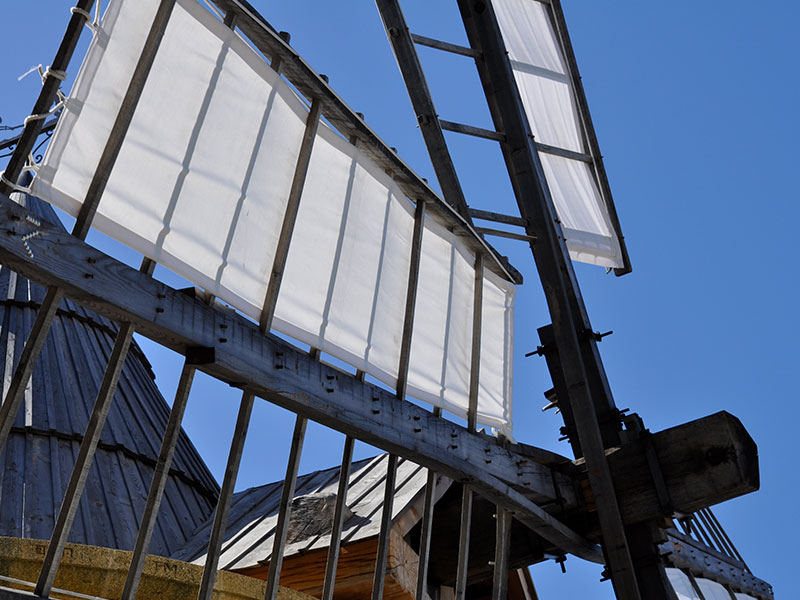
The mill's wings are positioned at the end of a shaft. They must always be positioned facing into the wind, and to achieve this, the roof and its mechanism are manually rotated 360° from the inside.
As they rotate, the wings carry with them a mechanism known as a spinning wheel with sprockets: this is a large wheel whose notches (sprockets) fit into another mechanism, the "lantern" (so called because of its shape). The lantern rests on a vertical axis (large iron), which is connected to the so-called "rotating" grinding wheel, which turns on a second, immobile grinding wheel (known as the "dormant" wheel). The friction between the two millstones crushes the cereal grains: this is the action of "grinding"!
It's very important that the wings don't turn too fast. The miller also has to rely on the strength of the wind and adjust the canopy to obtain a rotation speed for the rotating millstone of around 60 rpm, and he must ensure that the millstones aren't too close together. Indeed, too much or too fast friction can heat up the grains, altering the taste of the flour by giving it a "burnt taste".
Le moulin de Lambesc, or how to rise from the ashes
In the 18th century, Lambesc had seven water mills for oil production and three windmills for wheat, while the Moulin de Bertoire was built in 1806. Unfortunately, in 1882, it ceased to operate and was abandoned. The mill lost its wings shortly afterwards, then its roof and its mechanism.
It first belonged to the LEBRE family, who passed it on from generation to generation until 1929. Louise Augustine LEBRE, the family's last descendant, bequeathed it to her lady-in-waiting, Eugénie Philomène Octavie FROID. Her brother inherited the mill on his death in 1944 and sold it to SCI Bertoire in 1964. The commune of Lambesc became the owner in 1982 through an exchange of land.
A first attempt at renovation was launched in 1982 by the Amis du Vieux Lambesc association, but unfortunately the project was halted for lack of funds. The commune had a roof installed over the mill to protect it from the vagaries of the weather.
It was during the redevelopment of the Bertoire district that the restoration of the mill came back to the fore. It is being carried out by the association Conservation du Patrimoine de Lambesc, created for this purpose under the impetus of Albert Antoniol and a team of enthusiasts.
The restoration respects the Provencal tradition of windmills, reproducing the mechanism, the typical architecture of its buildings and using the original materials and methods. Note that the ashlars come from a Lambesc quarry.
Work began in late 2009, culminating in the inauguration in May 2013.
Financing was provided by donations from private individuals and local businesses via the Fondation du Patrimoine and public funds; the involvement of volunteers in the work was decisive,
Today, the mill plays an educational role, enabling the history of Lambesc and the trades from wheat to bread to be presented to all audiences.
There's nothing "banal"
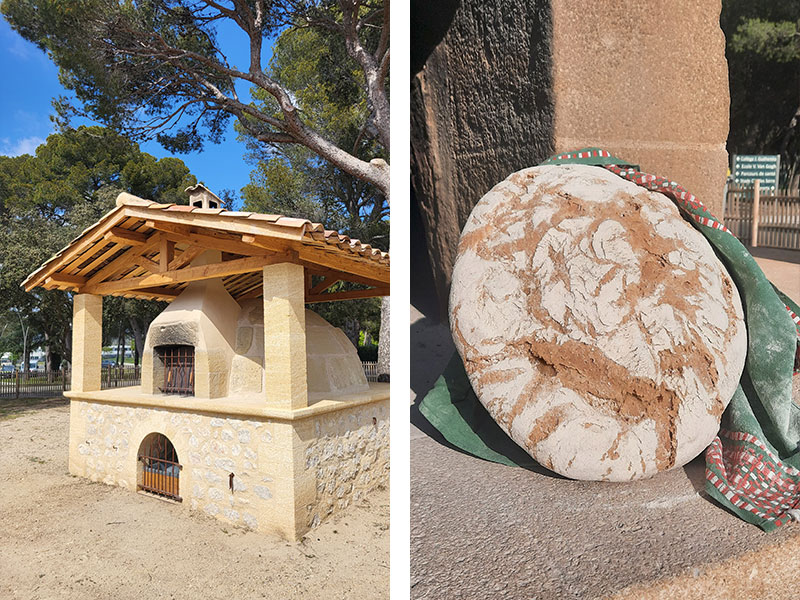
Near the mill stands a banal oven dating from the 17th century,
What is a banal oven ? From the Ancien Régime to the Revolution, it was a possession of the seigneur, which he made available to all inhabitants in return for a tax, " le ban ". All subjects of the seigneury must use this oven, and may not build another. In return, the seigneur was obliged to maintain and allow access to the oven, which was under the responsibility of bakers called fourniers : these baked bread for the week, or even the fortnight, forming large loaves with a thick crust to prolong shelf life.
Originally located on private land in a Lambesc hamlet (Janet), the oven was dismantled by members of the association Conservation du Patrimoine de Lambesc, then restored and installed in 2024 with the support of the Lambesc commune. With the treading area created nearby the same year, the entire bread-making cycle is now presented on the Bertoire mill esplanade.
Did you know ? The mills speak to you !
The position of a mill's wings signaled an event to the population : a wedding, the death of the miller, a long rest... In wartime, mills were a means of transmitting hidden messages to the population.