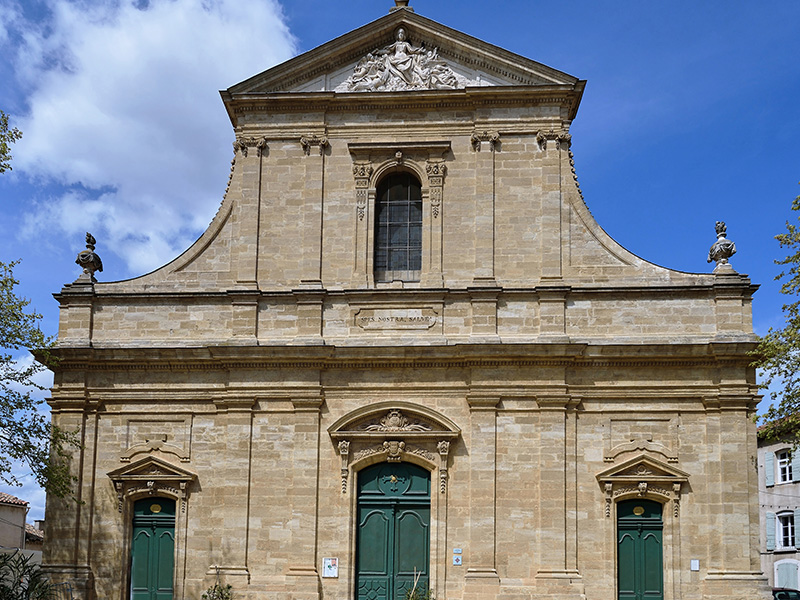
Facade - © Mairie de Lambesc
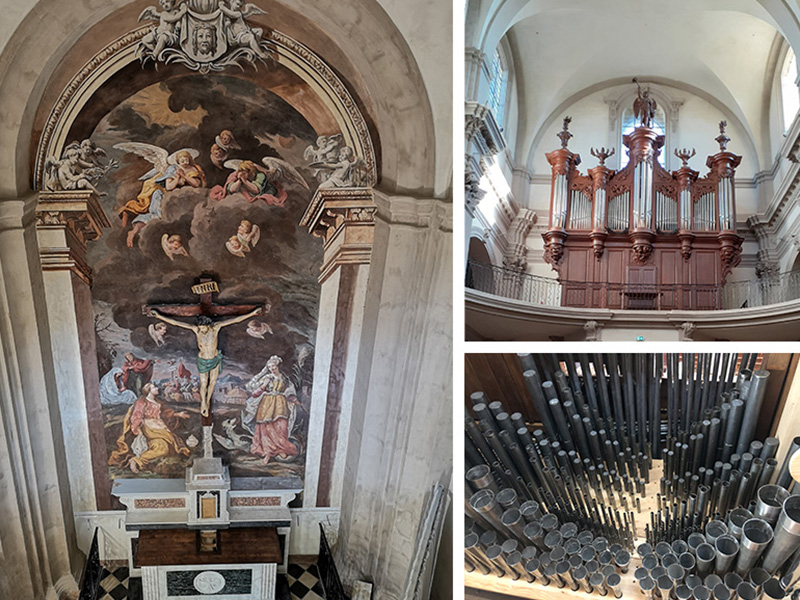
Isnard organ - © Mairie de Lambesc
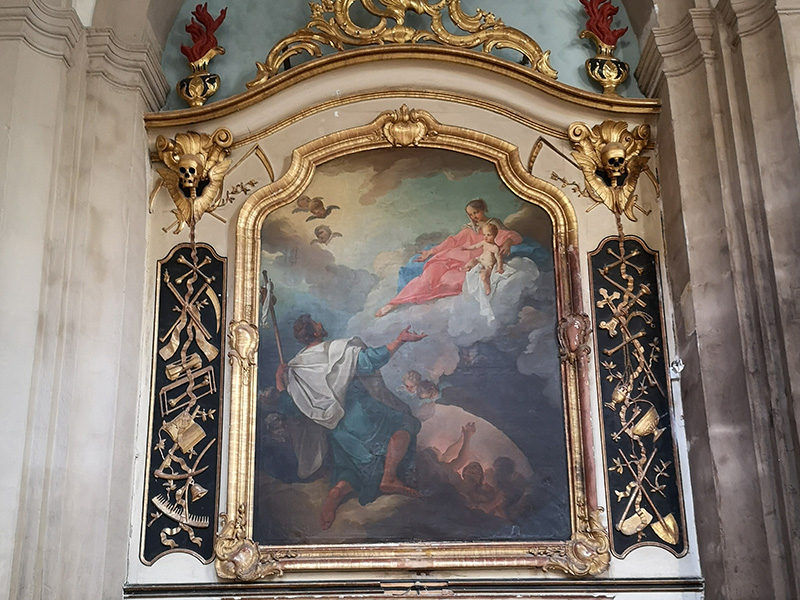
MF. Dandré-Bardon, Vision de saint Jacques - © Mairie de Lambesc
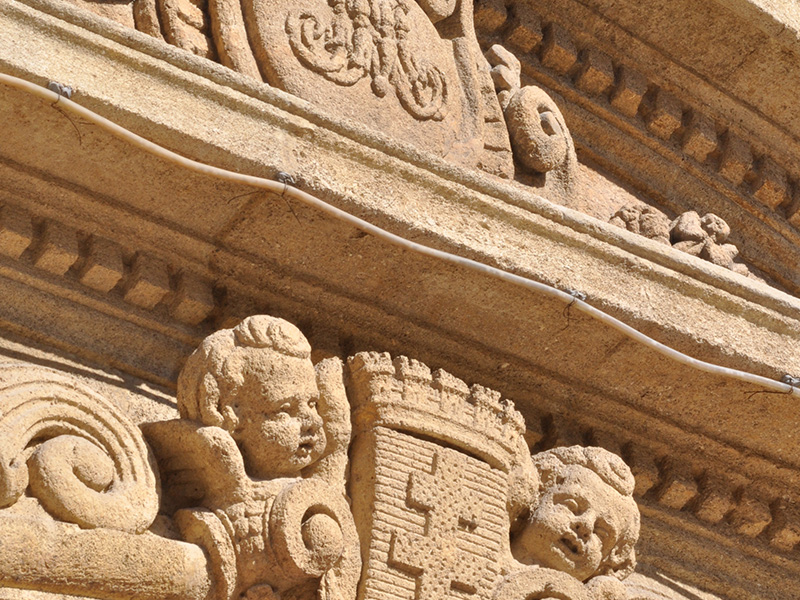
Central door tympanum - © Mairie de Lambesc
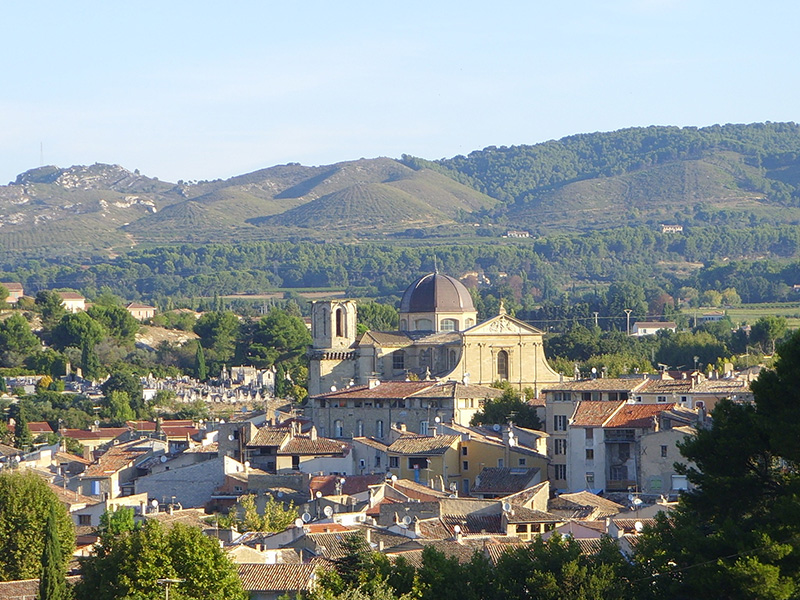
General view - © Mairie de Lambesc

L’église Notre-Dame de l’Assomption
Place des Poilus
The exterior :
Posed on a high point in the village center, Notre-Dame de l’Assomption, with its distinctive silhouette, is the work of the famous Provencal architect Jean Vallon, who also designed the nave of the Cathédrale Saint-Sauveur in Aix-en-Provence. The first stone was laid on April 29, 1700, and the work lasted 41 years. It was built on the site of the 13th-century church of Notre-Dame-de-la-Rose, deemed too small. The church tower, itself built on a tower of the former 9th-century fortified castle, remains. The bell tower's spire, badly damaged by the 1909 earthquake, was dynamited. Only one bell, the Gros Michel by Vard, remains of the four that existed at the end of the 18th century. The 1873 stained glass windows, by Allibert, will not be replaced. The imposing dome, elongated nave and pyramid-shaped facade are reminiscent of the Italian style of the late Renaissance. The sculpture on the façade's upper pediment is an Assumption realized by Lambescain Liotard in 1866. Dedicated to St. Mary, the church's patron saint is St. Michael. This is undoubtedly a reminiscence of the names given to the former parish and cemetery, which the inhabitants called Saint-Michel and those of San Pèyre, the first Lambescain home, Sainte-Marie.
The interior:
Lambesc's political rôle in the eighteenth century made it possible to build a church offering atypical volume and light for a Provencal village of this era. begun in 2018, the restoration work is considered to be that of the century by the experts in charge of heritage.
- 1ère nave work: Floor mosaic depicting the town's coat of arms, donated by the contractor who carried out the renovations in 1912. The floor covering conceals the Lamanon stone paving laid in December 1777. The town's coat of arms, azure, with a golden Lorraine cross, was given to Lambesc in 1453 by Yolande de Vaudemont, Duchess of Lorraine, when her father, King Renacute, gave her the newly purchased Seigneurie de Lambesc. These arms, representative of the cross of Anjou, only became the cross of Lorraine later, in 1477, when King René's grandson took it as a rallying sign in his fight against Charles le Téméraire, whom he defeated in front of Nancy.
- Chapelle de la Croix : Crucifix by Joseph Kappaler.
- Chapelle Saint-Crépin et Saint-Crépinien : Retable with green background framing a painting attributed to Dandré-Bardon depicting Les Frères Crépin et Crépinien, jugés par le préfet des Gaules » (1745). Note that the altarpiece is decorated with the tools of shoemakers, whose patron saint is Saint Crépin.
- Chapelle Sainte-Anne : Painting the "Visitation", 18th century work by the Provencal artist Jean-Baptiste De Faudran.
- Chapelle Notre-Dame de Lourdes : Initially prepared for the Trinitaires convent in Lambesc, the painting depicts the vision of Saint John of Matha in 1636 by the famous Parisian painter Nicolas Mignard.classified in 1912.
- Chapelle Saint-Joseph : Painting of « the death of Saint Joseph » (1649) by Jean Daret. Œuvre classified in 1912.
- Chœur : Maître-autel de Pezetti de 1827.painting of La Cène », XVIIIème siècle by Charles-Joseph Natoire. Œuvre inscrite à l’Inventaire des Monuments Historiques in 1975.
- Chapelle Notre-Dame du Rosaire : Paintings of The Apparition of the Virgin Mary to Saint Dominic and the Vision of Saint Blaise, patron saint of carders, by Reynaud Levieux de Nîmes (17th century).
St. Eldrad Chapel: Painting of "Saint Eldrad ressuscitant un mort à Novalaise » (1742), by Dandré-Bardon, représentant l’enfant de Lambesc.eldrad (781-875), abbot of the Novalaise abbey in Piacenza for 30 years, was canonized after his death. Relics of the saint were donated to the parish of Lambesc in 1743. With the relics came the story of Saint Eldrad: he was born in Lambesc, and the chapel of Saint-Pierre in the San Peyre district was built at his request. He became the town's patron saint and was honored as such. In 1872, Pope Pius IX made Saint Eldrad's Day Lambesc's second most important feast day. - Chapelle des Âmes du purgatoire : Tableau de la « Vision de saint Jacques » par Dandré-Bardon
Baptismal Font Chapel: Fresco of the Baptism of Christ by Jean-Baptiste Reboul and Joseph Castel from the first half of the 18th century and painting of La transverbération de sainte Thérèse by ’Ávila ».inscribed on the French "Inventaire des Monuments Historiques" in 1975.
Transept pillars: Sculptures from the four évangélistes d’Honoré Fossé. Œuvres inscrites à l’Inventaire des Monuments Historiques en 1975 - The organ: In 1788, the town council decided to proceed with the final embellishment by building an organ. Joseph Isnard (1740- 1828) was chosen for the instrumental part, while the carpentry and sculpture of the organ case were entrusted to Valatte. No doubt inspired by the masterpiece of his uncle Saint Maximin, in whose construction he had participated, Joseph Isnard had great plans for the organ. Unfortunately, the events of the French Revolution forced him to modify his plans and revise his plans downwards, with only 3 keyboards with back positive instead of four. Nevertheless, the Lambesc organ remains exceptional. The organ has stood the test of time, surviving the 1909 earthquake and the explosion of an ammunition train in August 1944. Nevertheless, a first renovation was necessary and carried out in the years 1970-1975. It will be followed by that of the Quoirin workshop, from 2018 to 2022, as part of the internal restoration of the church.
Source: Pierre GAZANHES