

Chemin du Petit Clos
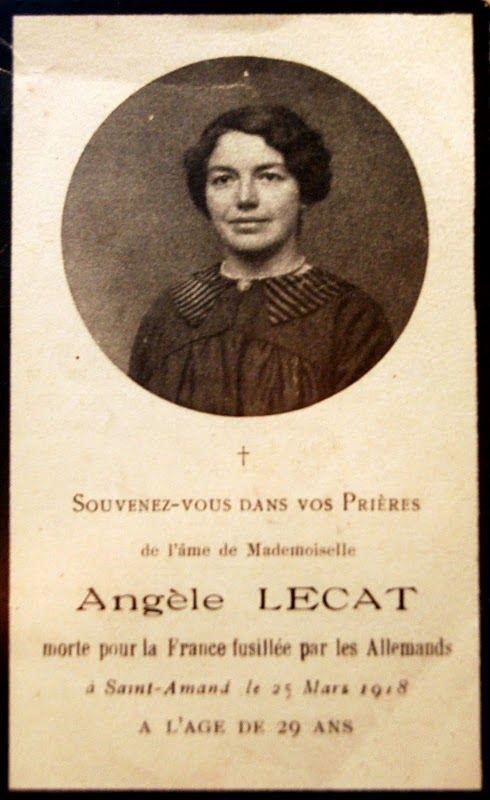
Angèle LECAT -
1889 - 1918
From a family of farmers, Angéle Lecat was born on January 11, 1889 in Rumegies.
During the Great War, Rumegies was part of the Kommandantur détape of Saint-Amand.She enters the resistance out of patriotism, family solidarity, piety. It also acts by resistance to the duality and arbitrariness of the occupation in the occupied North of France and the Ardennes.Angel Lecat practices two forms of resistance (surveillance and information, use of the pigeon), while being aware of the risks, because of the activity of the German counter-espionage. His accomplices will only have a prison sentence. His request for pardon from the Kaiser did not succeed, as he had not been sent by the officer Von Hellingrath who commanded Saint-Amand, who wanted to make an example of him. Angèle spent two months in the prison of Saint-Amand with a sister. They are separated. The last letter from Angégrave;le is addressed to her family: "Goodbye, dear parents, brothers and sisters, forgive my mother for giving you so much grief, pray for the repose of my soul, I have suffered so much, goodbye; (family archives)
Fired on March 25, and buried in the cemetery of Saint-Amand-les-Eaux, a memorial is now being built at the site of her death.
After November 11, 1918, Angéle Lecat is remembered as a martyr and a hero of the Great War. In 1919, her body was brought back from Saint-Amand-les-Eaux to Rumegies. A funeral was organized for her. In 1924, she received the Légion of Honor posthumously, the Croix de Guerre with palm, as well as the Médaille de la Reconnaissance Française. A citation and a stall shared with Louise de Bettignies and Emile Gressier in the Jardin de la Mémoire perpetuate the memory of his memory in Saint-Amand-les-Eaux.