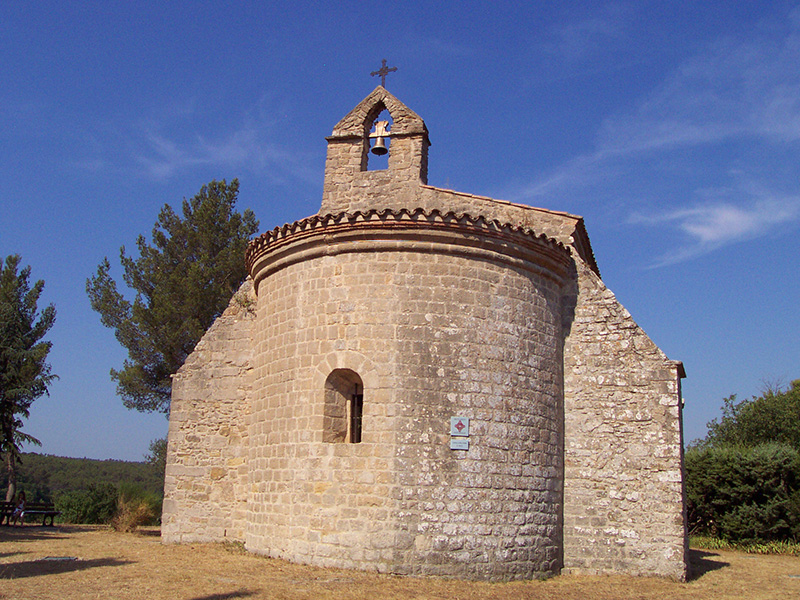

Chemin Saint-Pierre
La chapelle Saint-Pierre
The Saint-Pierre chapel, classified as a historical monument, was built behind the current cemetery on a well-cleared mound. In 1098, it is mentioned in the property of the abbey of Saint-Victor of Marseille where it was a parish church in the center of the first agglomeration. It was rebuilt in the 12th century in an architectural style of transition between Romanesque and Gothic art, as evidenced by its so-called Lombard vaults. But the plan respects the canons of Provençal Romanesque art, with a single nave and a semicircular apse to the east. The structure of the ribbed branches is archaic. The apse is narrower and lower than the nave. It has preserved an ex-voto from 1721, an old stoup, a painting on wood which seems to represent Joan of Arc, and four tombstones engraved with epitaphs dated from 1851 to 1856. In the 17th century, a hermit settled there. Between 1734 and 1740, the chapel was closed because it threatened to collapse. Powerful buttresses were then built. In the 19th century, it was owned by the Maurin family. Several members of this family are buried there, and four funerary slabs are preserved. In 1720, during the great plague of Marseille, the inhabitants of Peynier had vowed to come in procession every year to the chapel if Saint Peter would protect them from this plague. There was no victim of the plague in Peynier and since then, a mass is said every year at the chapel, on the Sunday following Saint Peter's day, the first Sunday of August. It is on this occasion that in 2003, a new bell was blessed and installed in the small bell tower.