
L’hôtel Dieu
L’hôtel Dieu
A mission : to care for the most destitute
A hôtel Dieu is a place of hospitality, i.e. a place of welcome for the destitute, orphans and pilgrims, administered by a religious order of the Catholic Church. The religious order of the Trinitarians was founded in the 12th century with the mission of redeeming Christian captives and bringing them back from the Holy Land to be received and cared for.
In Lambesc, the convent of the Trinitarians, located on what is now Place des Héros et Martyrs, was first home to the Hôpital de la Sainte-Trinité. It was later moved to Place du Castellas, in the village center, where it took the name of " Hôpital Saint-Jacques de la Miséricorde ". The Trinitarians continued to run the hospital from 1512 to 1646. They then left management of the Hôtel Dieu to the Pénitents Gris.
What is a pénitent gris?
Pénitents are members of a brotherhood, mixing lay and religious people and taking part in acts of charity and penance (self-giving to others). For certain occasions, they may wear a long robe girded by a rope and a hood over their head, making them anonymous.
In Lambesc, there were two brotherhoods of penitents : the blancs and the gris. It was the latter, from Aix-en-Provence, who settled here in the 17th century and took over the administrative management of the Hôtel Dieu.
A necessary transformation
In 1719, the Pénitents Gris gave responsibility for the Hôtel Dieu to the congregation of the Religious Hospitallers of Saint-Thomas de Villeneuve. However, barely ten years later, a survey of the parishes revealed a dilapidated building where only one woman, aged around sixty, looked after the sick.
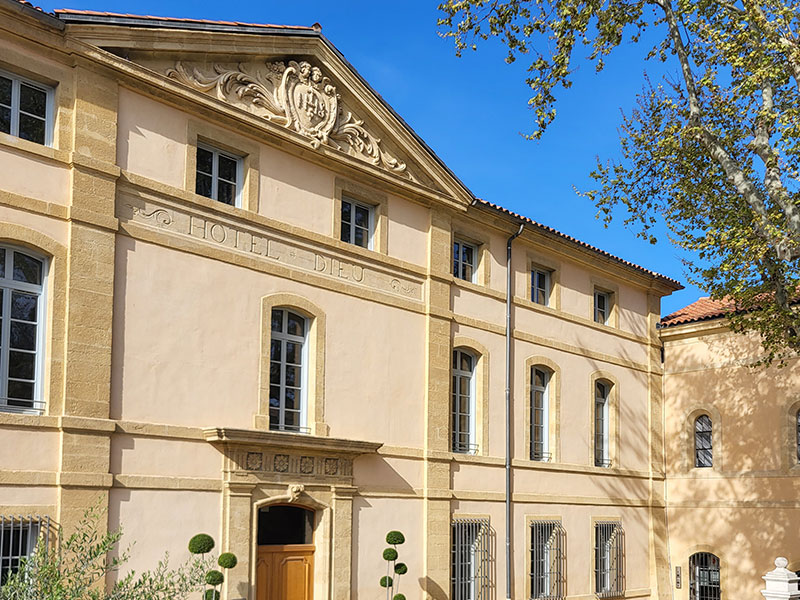
To deal with this situation, the Lambesc municipality decided to demolish the Hôtel Dieu and build a new one a few hundred meters away in the direction of Rognes. Construction lasted from 1735 to 1769. At the beginning of the 19th century, the Hôtel Dieu was mainly used by the military, but gradually began to open up its services to civilians. By the end of the 19th century, it had 34 beds.
The nuns looked after the establishment until 1929, when they were replaced by lay staff, the municipality having received the building from a bequest in 1904.
Unfortunately, on August 16, 1944, at Lambesc station, a German ammunition train was machine-gunned by Allied forces and exploded. The impact was so powerful that the Hôtel Dieu, close to the station, was severely damaged and closed for restoration until 1957. A few years after its reopening, however, the Hôtel Dieu closed for good.
It found a new purpose from 1996 until 2018, hosting the vocational program of Aix-Marseille University's Department of Education Sciences.
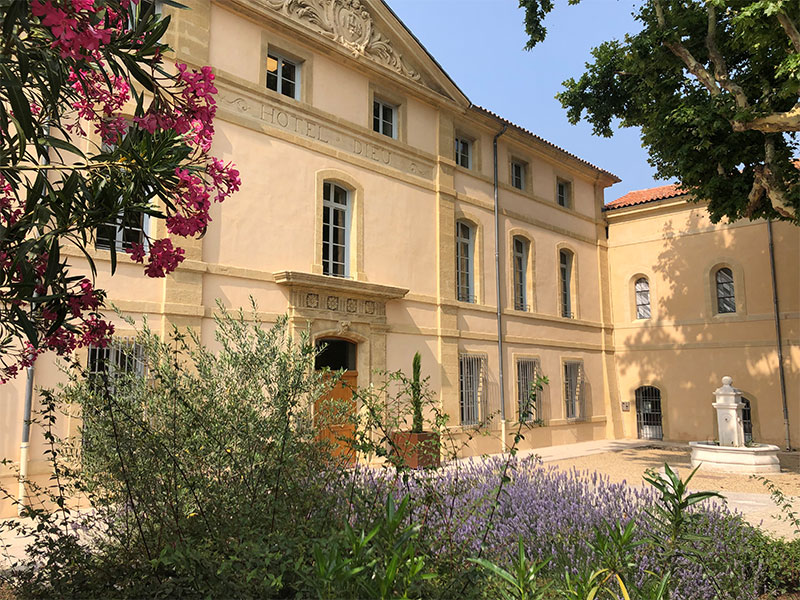
Today, the renovated Hôtel Dieu is home to administrative offices, associations and healthcare facilities.
From the Saint-Jacques chapel to the Espace Saint-Jacques
Attached to the Hôtel Dieu, the chapel was built at the same time. In 1936, the chapel became totally disused, and the municipality, which owned the building, offered the Association des Amis du Vieux Lambesc the opportunity to occupy the walls and display the museum's collections. More than 400 items were stored there.
But the explosion of the German ammunition train in 1944 seriously damaged the building and the museum's collections, most of which were destroyed when the roof fell in. After restoration, the building is used as a municipal hall.
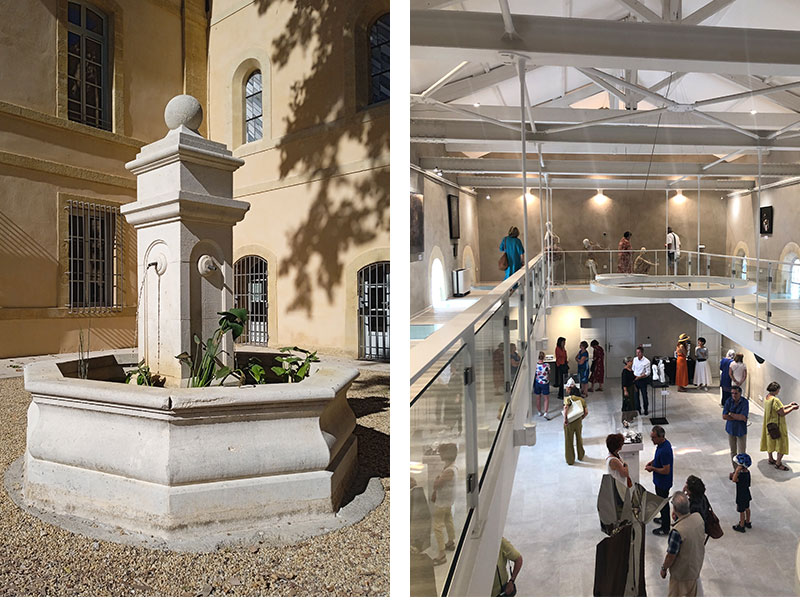
In 2021, the chapel is fully restored at the same time as the Hôtel Dieu, and becomes the Espace Saint Jacques. Its purpose is to host exhibitions by local artists and professional seminars.
A gallery in a hospital ?
A Hotel Dieu operates thanks to charitable souls. Donations from the latter enable patients to be fed, housed and cared for with the appropriate products. As a thank-you when a donation is made to the hospital, the painted portrait of the generous donor is hung alongside the other benefactors forming a portrait gallery in their memory, a veritable little painting museum within a hospital !
These portraits hang today on the walls of the Musée du Vieux Lambesc.