
Rue des Glacis
Glacis
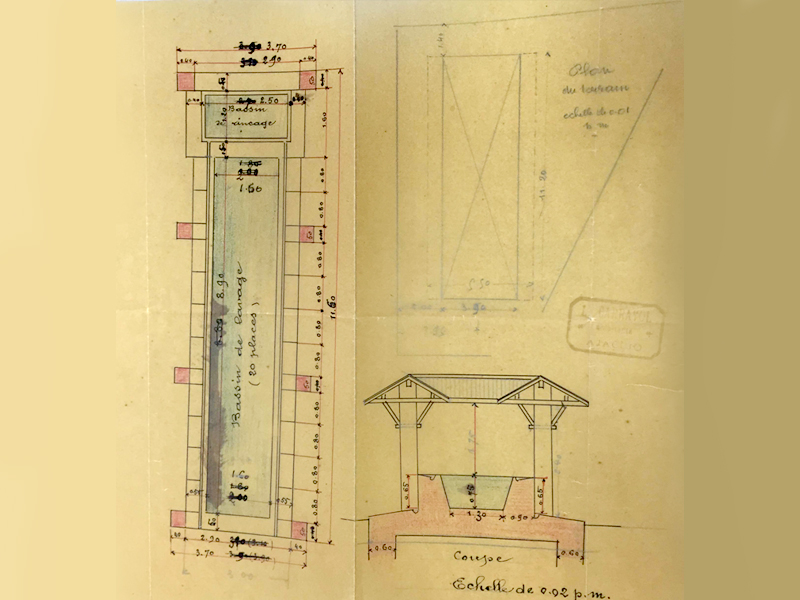
In military architecture, the glacis is a term originally used to designate an open area, generally built on a gentle slope from the outer elements of a fortified structure, on the counterscarp. Its main function was to provide no shelter for potential attackers of the stronghold and to clear the field of vision of its defenders. At the end of the 18th century, Ajaccio lost its vocation as a military place. In 1811, Ajaccio became the administrative capital of Corsica. When Bonaparte became Consul in 1799, he launched his plan for the embellishment and enlargement of Ajaccio following several priorities, including the destruction of the military fortifications. The street that was built in place of the glacis will keep their name. At the beginning of the 19th century, the construction of buildings around the current Place Foch left an unbuilt space in the Rue des Glacis. This place was chosen by the municipality for the construction of a new washhouse. The washhouse was to be covered by a roof built on a wooden frame on steel beams resting on ashlar and concrete pillars. On 3 June 1929, the town council gave permission for the water to be collected by installing a pipe connected to an existing water supply on the odd side of the Place Foch. The washhouse was still in use until a fire destroyed the frame in 1990. Today, the other washhouses in the town centre have been demolished and only the one in the Rue des Glacis remains.