Their story.
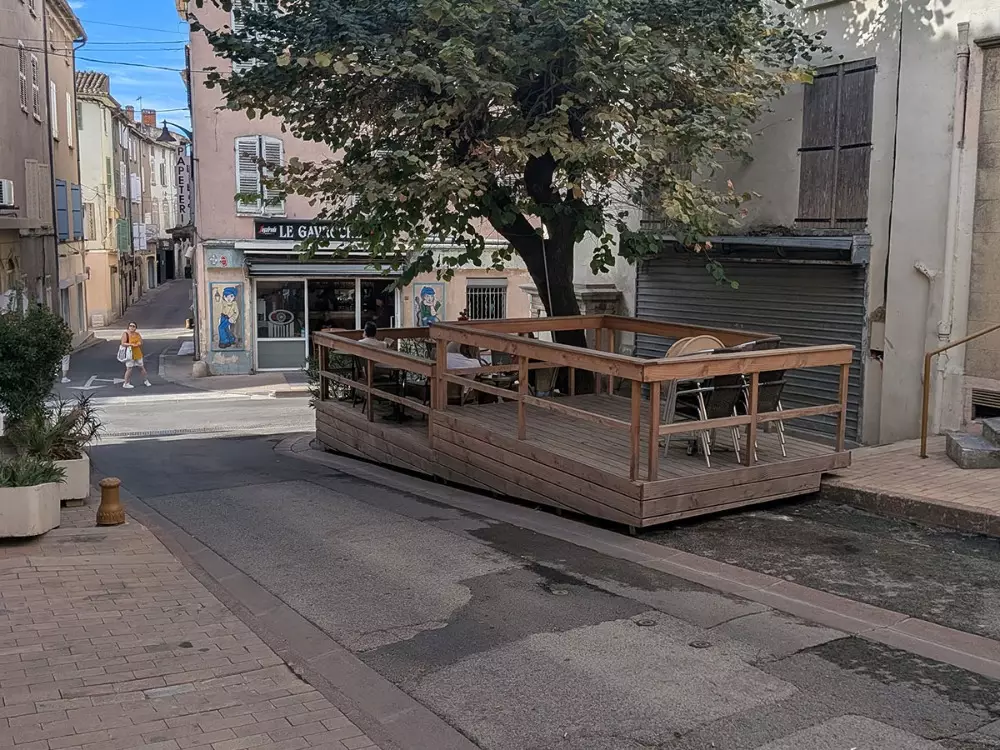
Renamed Place Vaillant-Couturier, this small square in the historic center has long been the heart of the village. Its former name and what lay buried beneath its cobblestones speak volumes about the history of Le Luc. It was called “Place aux Herbes” not because of its grass: in Provence, “herbes” refers to vegetables. It was here that the market was held for many, many years, starting in 1914. A market that has since expanded far beyond its original boundaries: every Friday morning, about a hundred stalls now fill the town center. The square is now named after Paul Vaillant-Couturier (1892–1937), a writer, World War I veteran, journalist, and member of parliament—a name that, like the nearby Jardin du 4 décembre 1851, recalls the town’s republican and working-class roots from the days of the tanneries, silkworm farms, and bauxite mining.
- An underground passage beneath the feet of passersby. An underground passage was discovered beneath the square that connected the Château des Mascs to the Church of Notre-Dame de Nazareth. A shortcut for safety or discretion, as was common in many fortified villages in Provence. Today, the underground passage has disappeared.
- The “Mascs” are witches. The castle’s name is no coincidence: in Provençal, “masco” means “witch.” Perched on Castellas Hill, the ruins of this medieval fortress—occupied as early as the 12th century—were nicknamed the “Mascs’ dovecote” because of the nocturnal birds that nested there. It was the stuff of late-night tales. The last remaining structures were destroyed in 1971 during the construction of the highway.
- A church of which only one wall remains. Notre-Dame de Nazareth, to which the underground passage led, had become too small by the 17th century: a perpendicular nave was added to it. Demolished in the 19th century, only the eastern wall and its four engaged columns remain, now designated as historic monuments. Just a stone’s throw away, the 27-meter-tall hexagonal tower, built between 1517 and 1546 by master builder Caron de Brignoles, served as both a bell tower and a watchtower.